

A Complex Market Requires a Clear Process
In the first part of this series of articles about the marketing automation tool selection, we showed just how confusing the MarTech market has become. Features, integration capabilities, pricing models, service quality, and scalability vary (sometimes significantly) from provider to provider, and the number of available platforms continues to grow. We highlighted criteria that can be used to categorize and compare providers.
But this immediately raises the next question: How do you actually make a selection? Where do you start: with the tool or with the strategy?
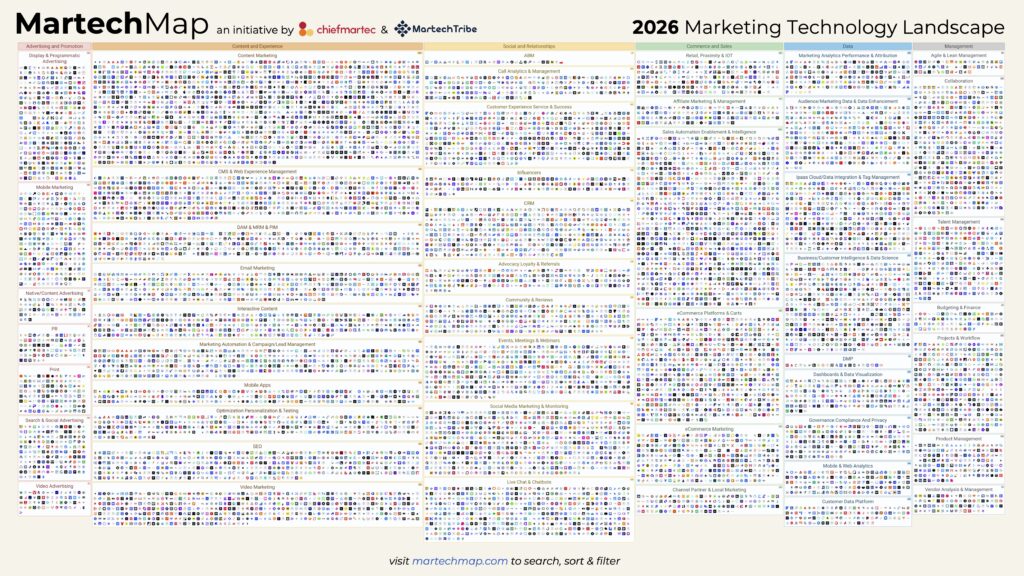
The complexity of the marketing technology landscape. Source: Marketing Technology Media, 2026
In practice, we repeatedly see companies starting the selection process with a long list of providers without first clarifying which requirements actually stem from their own marketing and sales strategy. The result: demos are evaluated based on gut feeling, requirements are only defined afterward, and the result is a system decision that, while technically impressive, misses the actual business goals. There’s a lot of uncertainty: too many options, too much fear of making a bad investment, and too little internal clarity about responsibilities and decision-making criteria.
This article shows what a structured marketing automation tool selection process looks like that avoids precisely these pitfalls.
Strategy Before Tools: The Right Starting Point
- In-depth MarTech product knowledge: experience with a wide range of platforms and providers, including their strengths, weaknesses, and typical use cases.
- Extensive experience in marketing and sales strategy: processes, personas, customer journeys, and the business requirements that arise from them.
The 4-Phase Approach to Marketing Automation Tool Selection
To move from the initial idea to a well-founded system decision, we use a structured, four-phase approach. Each phase builds on the previous one and delivers a clearly defined outcome as the basis for the next step.
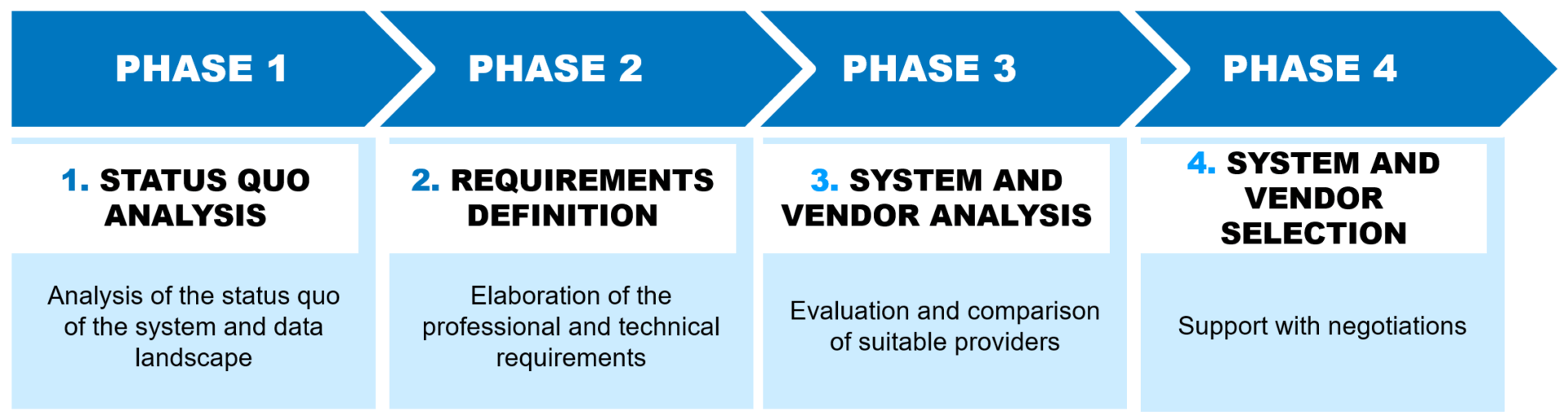
Stepwise Marketing Automation Tool Selection Process
Phase 1: Status Quo Analysis
Before discussing new systems, we must establish transparency regarding the existing system and data landscape. This assessment serves as the starting point for all further decisions.
A kick-off workshop with all relevant stakeholders from marketing, sales, customer service, and IT serves as the starting point. This is followed by a document analysis: existing systems, processes, and data flows are systematically reviewed. In structured stakeholder interviews with the business units and IT, first-hand insights into experiences, pain points, and requirements for the future system are then gathered. Potential “quick wins” are also documented and noted for use in subsequent phases.
The result is a current state report featuring system, data, and process maps, as well as initial hypotheses regarding particularly important areas for action.
The processes and pain points of marketing, sales, and customer service are identified and thoroughly documented. The existing system landscape and all relevant integrations are fully mapped. This provides certainty and avoids unpleasant surprises in later project phases.
Phase 2: Requirements Definition
Business and technical requirements are now systematically derived from the strategy, not the other way around, from a vendor’s predefined feature list.
During use-case workshops, specific use cases are developed, such as lead nurturing, segmentation, or cross-channel campaigns. In collaboration with the relevant departments, these use cases are transformed into user stories that specify the requirements from the users’ perspective. The requirements are then prioritized, for example, using the MoSCoW method (Must-have, Should-have, Could-have, Won’t-have). At the same time, the technical framework is coordinated with the IT department, including data protection, interfaces, and system architecture.
The result of the second phase is a prioritized requirements catalog that equally reflects business and technical requirements, as well as validated use cases that serve as the basis for evaluation in the next phase.
The most important benefit of this step is the list of real requirements that reflect specific campaign and customer journey needs, rather than abstract feature requests. The interfaces to the CRM and other systems, as well as the lead handover process from marketing to sales, are also considered from the outset rather than being addressed retroactively. From the IT perspective, the advantage is that technical requirements are developed in collaboration with the business units, rather than remaining a downstream, mandatory task for IT.
Phase 3: System and Vendor Analysis
In this phase, an objective, transparent evaluation of the available systems is conducted based on the requirements defined in Phase 2.
Approach and Methodology:
Stage 1 – Preselection: A broad market screening identifies generally suitable vendors and systems. These are evaluated based on strict elimination criteria to reduce a manageable long list to a reasonable number.
Stage 2 – In-Depth Analysis: A detailed evaluation is performed for the remaining shortlist (typically three to five providers).
At the core of the in-depth analysis is a weighted scoring model. This can be customized to the specific company to account for its concrete plans and requirements. An example evaluation scale: Each requirement criterion is rated for each system or provider using a clear evaluation logic:
Score
Meaning
0
5
Requirement is partially met or met with restrictions
10
Requirement is fully met
Example evaluation model
This raw score is then multiplied by the weighting from the prioritization in Phase 2. A “must-have” criterion thus contributes more heavily to the overall result than a “nice-to-have.” In addition, the evaluation dimensions from the first article in this series are factored in: feature set, integration capabilities, cost structure, service quality, and scalability.
Upon completion of this phase, a transparent, traceable scoring and ranking of the vendors on the shortlist serves as a clear, documented, and auditable basis for decision-making. This gives system users the assurance that their own business requirements have been evaluated objectively and weighted according to their priority.
Phase 4: System and Vendor Selection
Finally, the actual decision must be made regarding the selection of the right system under the best possible terms.
Specifically, demo sessions and negotiations are scheduled with the vendors of the systems that best meet the company’s requirements. Reply offers strategic and operational support and guidance in this area. Product demos are typically conducted by the vendors using two specific use cases relevant to the company. This reveals how a system actually performs in practice, and not just in the theoretical context of a feature comparison.
Reply can also assist in drafting RFP (Request for Proposal) documents to serve as a solid basis for negotiations. Based on the product demos and the negotiations, a final, concrete recommendation for a system is developed.
This approach ensures future user acceptance and a practical, real-world assessment. The system is demonstrated based on the company’s own prioritized use cases; there is no “black box” decision imposed from above. For the IT department, this provides clarity from the outset regarding the integration requirements and technical prerequisites of the selected system before the contract is signed.
Why Choose Reply?
Reply combines two areas of expertise that are rarely found under one roof when selecting tools: in-depth product and platform knowledge of market-leading marketing automation systems (including HubSpot, Salesforce Marketing Cloud, Oracle Eloqua, Adobe Marketo Engage, and Microsoft Dynamics Customer Insights), as well as many years of experience in developing marketing and sales strategies, lead management processes, and customer journeys.
Reply is vendor-neutral and can therefore provide an objective assessment without being influenced by the sales interests of any single provider.
Beyond simply selecting a system, Reply also provides support for implementation, integration into the existing system landscape, and the development of automated campaigns and programs built on the selected system. Selecting the right tool is therefore often the beginning of a long-term partnership.
Conclusion
Choosing the right marketing automation tool is not a matter of the best feature set, but rather of the system’s optimal fit with both overarching strategic and day-to-day operational requirements. Those who follow the proper sequence (first clarifying strategy and requirements, then evaluating systems) make a sound, well-reasoned decision.
A structured, multi-step selection process like the one described here ensures that wrong decisions are avoided and that all relevant stakeholders are involved from the start, such as marketing, sales, customer service, and IT. The result is a system decision that not only makes technical sense but also truly aligns with the company’s business goals.
Are you looking for a marketing automation tool that’s right for your company? We’d be happy to help you define your requirements, compare systems and providers, and select a solution. We are looking forward to hearing from you!

Marketing Automation with Like Reply
Like Reply is a specialized expert in digital communication with offices in Munich, Milan and Paris. We support companies in the introduction and development of automated communication as well as in the systematic, effective management of leads and customer relationships. Contact us without obligation and find out how we can take the use of Marketing Automation to the next level together.