

FIND OUT MORE
SERP is evolving rapidly, and so is the way users interact with search results.
AI Overview is a clear example of this trend: can we estimate its impact on the performance of sponsored ads?
I run a search on Google, read the AI-generated result, find the information I need and close the tab.
No click on paid results, no website visit from an organic result.
How many times have we done this over the past few months?
AI Overview has amplified the zero-click search phenomenon: users increasingly stop at the information displayed directly on the SERP without visiting any website.
At the same time, the visibility of organic and sponsored results may be reduced when they appear below AI-based results.
This major change in the way people interact with search results has inevitably led to a drop in organic CTR and, consequently, to significant implications for SEO.
What about paid search campaigns?
What impact is AI Overview having on the performance of sponsored ads on the SERP?
Are media KPIs such as CTR, CPC or Impression Share being affected by changes in the composition of the SERP?
Answering these questions is highly complex because campaigns are influenced by exogenous factors (such as market trends, competition and seasonality), while also undergoing proactive changes and optimisations over time (such as bid strategy reviews, budget changes, structural adjustments or the introduction of new features such as AI Max).
A change in KPIs after the release of AI Overview therefore does not necessarily imply a cause-and-effect relationship with the feature.
Our expertise, experience and access to a large volume of aggregated data from the campaigns we manage enabled us to investigate the topic in depth using a methodology that involved:
- analysing a significant sample of impressions (almost 20 million collected from April 2025 to June 2026), distributed across approximately 35,000 unique search terms from Google Search campaigns for brands operating in different industries (Automotive, Energy, Finance, IT and Telco) and markets;
- matching these Google Ads search terms with third-party tool databases and using a proxy to estimate whether AI Overview had been displayed for each term during a given period.
The analysis produced the following insights.
Let’s start with the query analysis
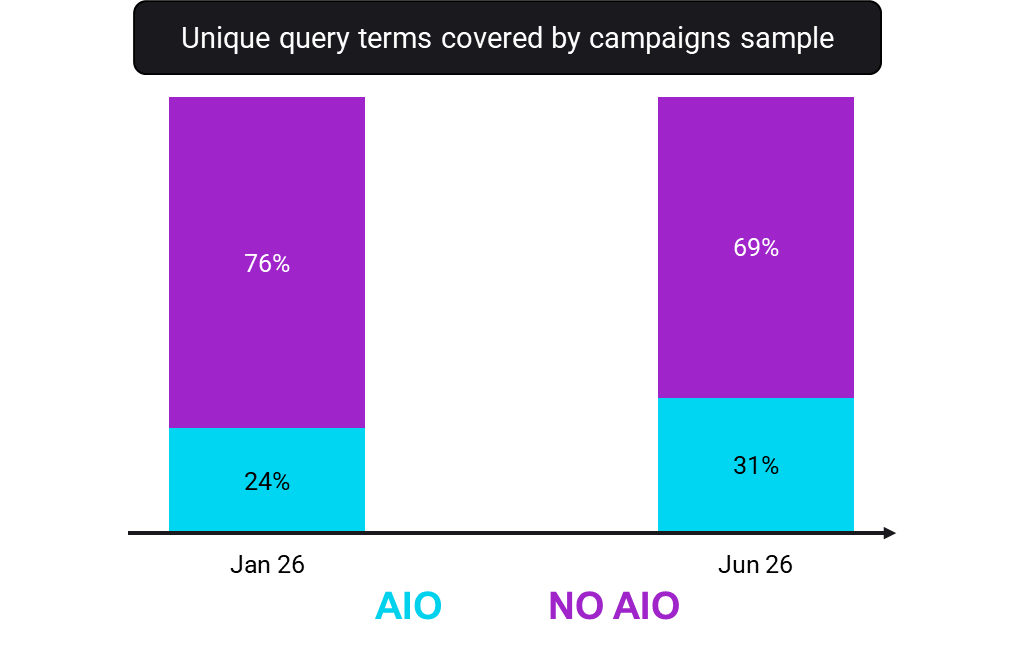
AI Overview was displayed for approximately 24% of the unique searches captured by the campaigns and analysed in January 2026; this figure rose to 31% by June 2026.
AI Overview is expanding its presence
Informational and generic searches are more frequently affected by AI Overview (estimated to have been displayed in January 2026 for 50%+ of the analysed terms of this type) than transactional searches (37%), Brand + product/service searches (20%) and pure brand searches (<5%).
However, when analysing the same queries in June 2026, a significant increase in AI Overview publication is recorded for transactional searches (+16 percentage points).
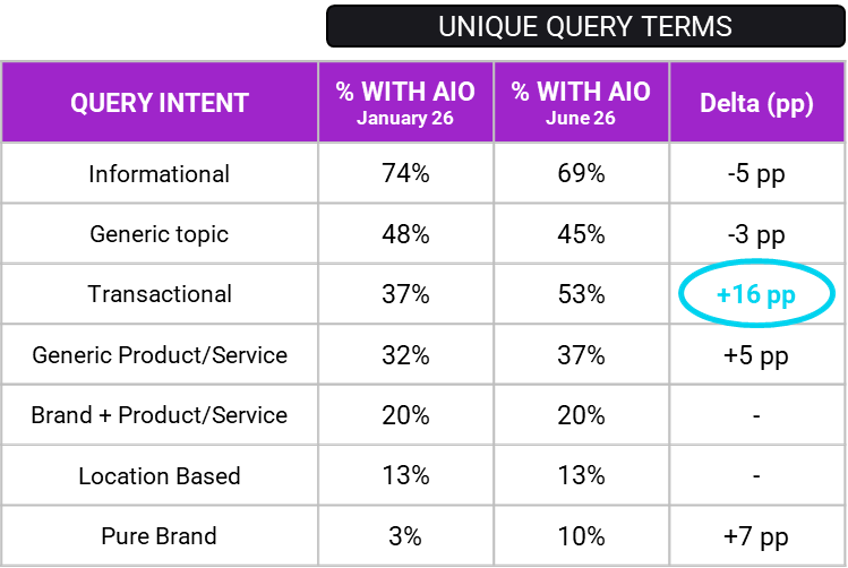
AIO was initially more focused on informational queries, but it is increasingly extending its presence to transactional ones as well.
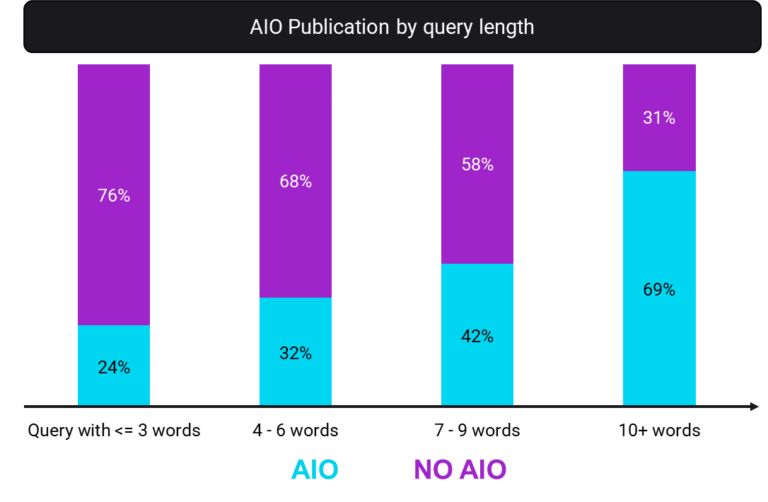
Queries containing 10+ words are more heavily affected (AIO is estimated to have been displayed for almost 70% of the analysed queries of this type) than shorter queries (<30% for searches with fewer than 3 words); this difference remains broadly consistent over time, from January to June 2026.
Longer and more complex queries trigger AI Overview more frequently
Let’s now shift the focus from queries to impressions
Because most of the campaigns analysed are strongly performance-oriented and focused on conversion objectives, impressions are mainly concentrated on:
- brand-related, product-related or transaction-related searches (only 10% of the impressions analysed come from informational or generic searches);
- short searches (75% of impressions are generated by searches containing no more than 3 words).
In other words, the campaigns analysed are more heavily focused on the types of searches that are typically less affected by AI Overview.
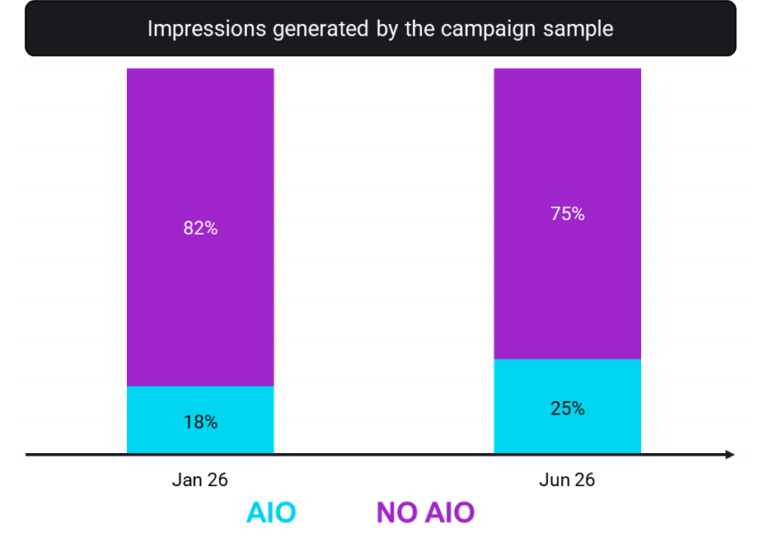
As a result, it is estimated that only 18% of the impressions analysed involved an ad appearing alongside AI Overview, a percentage that rose to 25% in June.
This suggests that ad–AI Overview coexistence is still relatively limited compared with overall searches on the SERP, but also that it has been steadily increasing over the months.
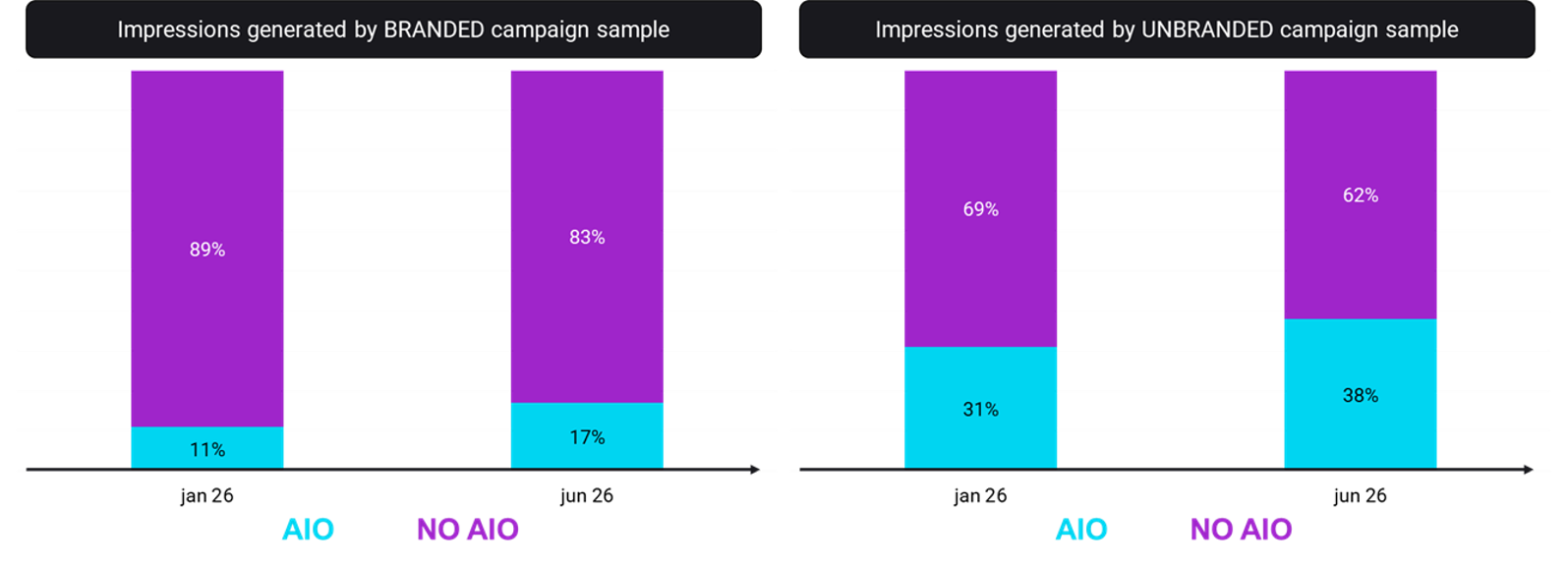
The analysis also indicates that Brand campaigns encounter AI Overview less frequently than Generic campaigns (11% vs 32% of impressions in January 2026, with both percentages increasing over the following six months).
So, what is the impact of AI Overview on Paid Search campaigns?
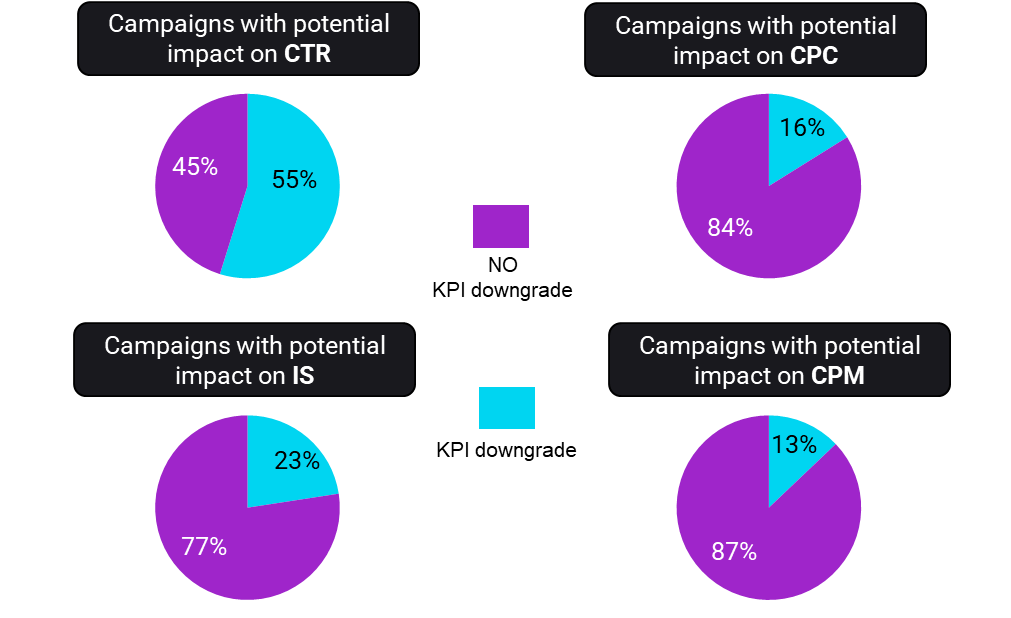
Looking at the subset of campaigns with the highest share of impressions linked to queries where AI Overview is estimated to be present, KPI trends are mixed. Following the release of the feature:
- CTR declined for around half of the sample, while for the other half it remained stable or even increased;
- CPC, CPM and Impression Share worsened in only around 15%-25% of the sample, while the remaining campaigns saw these KPIs remain stable or improve.
Looking more closely at the KPI that recorded negative changes across the largest number of campaigns after the release of AIO — CTR — no correlation emerges between its variation and the percentage of impressions with AIO: the campaigns estimated to have the highest share of impressions with AIO are not those experiencing the largest declines in CTR.
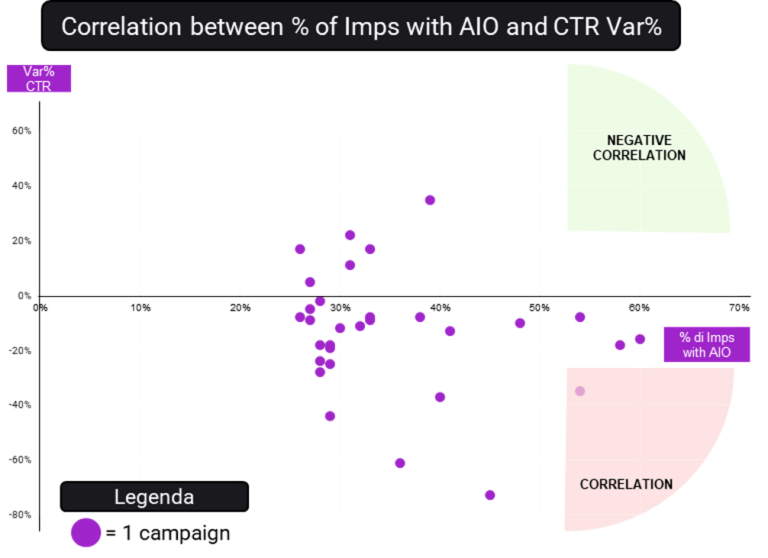
Even when considering campaigns that, between January and June 2026, recorded a significant increase in the share of impressions on queries featuring AI Overview, no common pattern emerges.
In conclusion
As noted at the beginning, campaigns are extremely dynamic and subject to both exogenous factors and endogenous changes that affect performance, making it impossible to isolate the impact and establish a cause-and-effect relationship.
What can be said with certainty is that the potential impact depends on the structure of the keyword set and, consequently, on the searches captured by a campaign.
But we cannot stop there: with equal certainty, we can say that AI-generated results are expanding and evolving their presence and, as a result, changing the way users consume content.
In this context, campaigns cannot stand still. They need to ride this inevitable wave by making thoughtful and informed use of the native AI-based features that Google is making available.
Monitoring how the landscape evolves and progressively adapting strategies and tools will therefore be essential to understand — and consequently manage — an increasingly AI-driven SERP.
If you would like to learn more about this or other industry topics, contact us!

Let’s transform your digital landscape together
Unlock the full potential of your digital presence with our expert marketing strategies designed to drive growth, engagement, and conversion. Connect with us today to transform your vision into success.